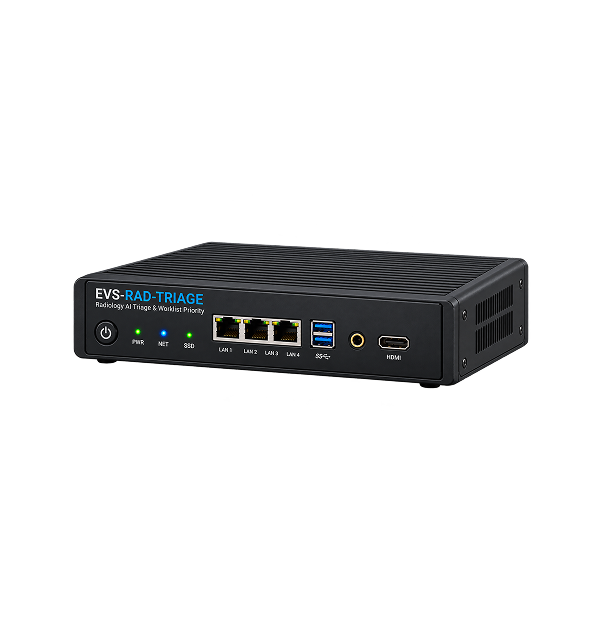
Radiology AI Triage & Worklist Priority (EVS-RAD-TRIAGE)
On-prem AI that flags time-sensitive imaging studies and reprioritizes the radiologist worklist, notification and triage in parallel to standard of care, so critical findings such as suspected ICH, LVO, or PE patterns surface faster without replacing the diagnostic read.
 DICOM study triage
 Critical-finding prioritization
 Worklist reprioritization
 PACS / RIS notifications
 Mobile escalation
 On-prem edge inference
 Parallel to standard of care

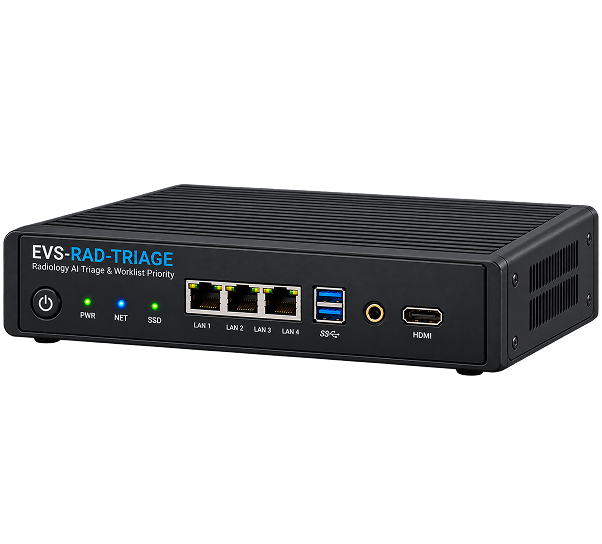
In acute imaging, the bottleneck is often not acquisition, it is which study a radiologist opens next. Radiology AI Triage & Worklist Priority sits in the DICOM path to automatically flag time-sensitive exams and push them up the worklist. Triage classifiers look for patterns associated with high-stakes findings, for example suspected intracranial hemorrhage on non-contrast head CT, large-vessel occlusion cues on CTA, or pulmonary embolism patterns, then notify PACS/RIS workflows and escalate to mobile when configured. The clinical posture is deliberate and commercial-safe: this is a notification / triage layer that runs in parallel to standard of care. It does not replace the radiologist’s diagnostic interpretation. Hospitals often prefer on-prem / edge inference to cut latency and keep imaging data local. The appliance joins the hospital network over RJ‑45 Ethernet (and Wi‑Fi / Bluetooth where the deployment allows), with optional LTE via mini‑PCIe for constrained sites; resilient power, plug-in supply with battery backup, and solar where a remote imaging node needs it, keeps triage available through brief outages.
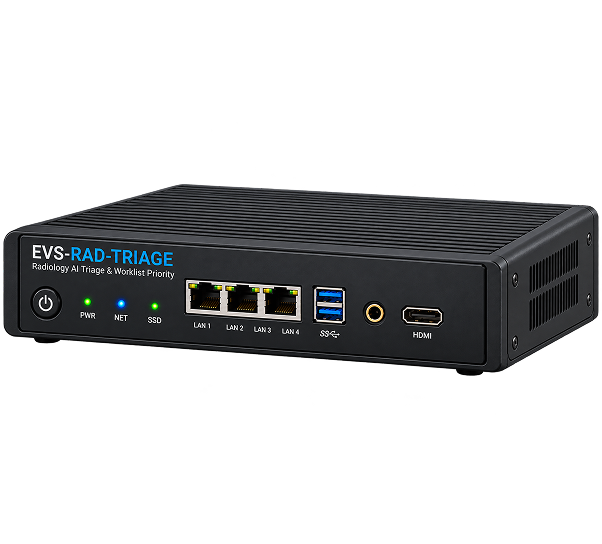
Radiology AI Triage & Worklist Priority (EVS-RAD-TRIAGE) — Flag the urgent study. Raise it on the worklist. Keep the diagnostic read with the radiologist, on-prem triage that respects standard of care.
Specification
General
- Product nameRadiology AI Triage & Worklist Priority (EVS-RAD-TRIAGE)
- Product codeEVS-RAD-TRIAGE
- RoleOn-prem / edge AI triage and worklist prioritization for time-sensitive radiology studies
- CategoryEdge Vision Systems
- VerticalMedical & Healthcare
- Suggested priceInquire
Imaging AI & clinical workflow
- InputDICOM series routed from modalities / imaging network