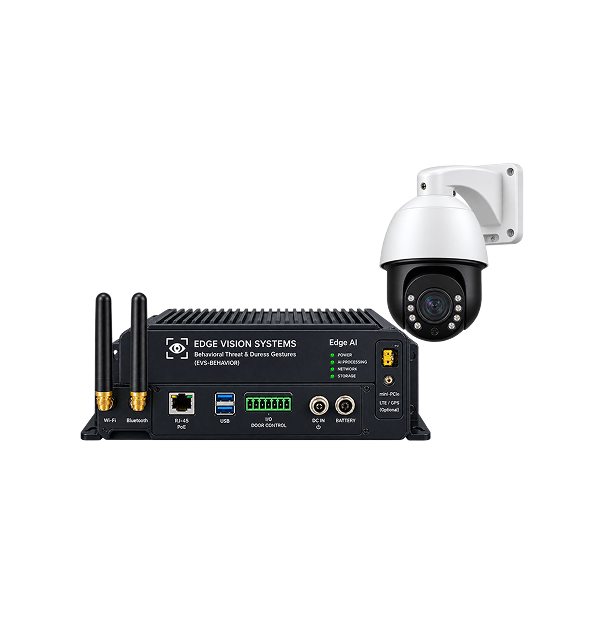
Behavioral Threat & Duress Gestures (EVS-BEHAVIOR)
Edge AI that reads dangerous human behavior — fights, assaults, and coercion cues — while authorized staff can use safe disarm gestures, and duress can be signaled by pose or voice, with audit logs, PTZ follow-up, Wi‑Fi, Bluetooth, and RJ‑45 Ethernet (optional LTE and GPS via mini‑PCIe), plus solar, plug-in power, and battery backup when electricity fails.
 Pose · action recognition
 Fight / assault / coercion cues
 Safe disarm gestures
 Duress pose · voice keywords
 Optional face authorization
 PTZ follow-up · audit trail
 Wi‑Fi · Bluetooth · RJ‑45 · PoE

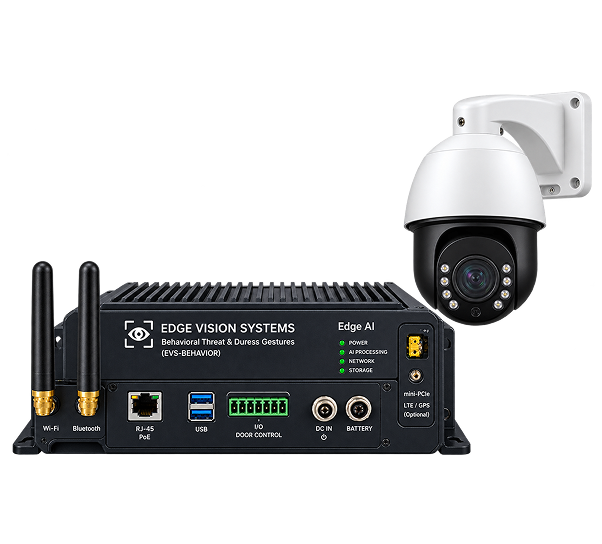
Not every threat shows a weapon in clear view. Sometimes the danger is in how people move, a fight breaking out, an assault in progress, coercion in a secure corridor. Behavioral Threat & Duress Gestures watches for those patterns with pose estimation and action recognition on the edge, then flags the event for faster intervention. In the same system, authorized personnel can use predefined safe disarm gestures to suppress alarms when they are legitimately handling a situation, and duress signals (pose and/or voice keywords) can raise help when someone cannot openly call for it. Multi-modal confirmation is the commercial point: vision behavior cues, optional face recognition for who is authorized to disarm, and optional voice keywords for duress, analyzed locally so sensitive video and audio are not forced to the cloud for every decision. A PTZ path supports follow-up views after a fixed-camera flag. Door-control interfaces can coordinate with access zones. Networking uses Wi‑Fi, Bluetooth, and RJ‑45 Ethernet with PoE; remote posts can add LTE and GPS via mini‑PCIe. Local storage keeps an audit trail. Power includes solar, plug-in supply, and battery backup so behavioral analytics stay alive through outages.
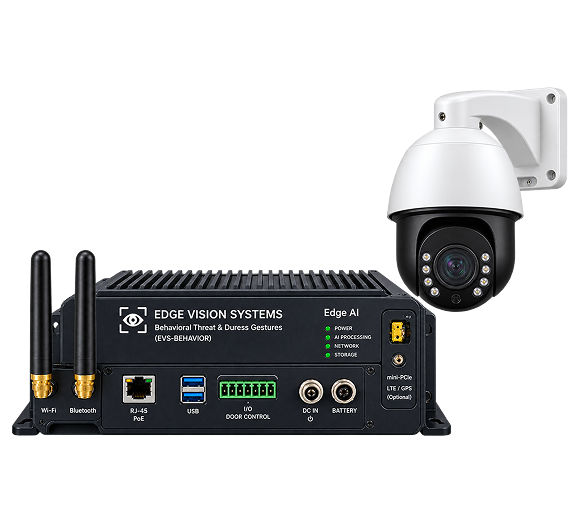
Behavioral Threat & Duress Gestures (EVS-BEHAVIOR) — Flag the threat. Confirm who can disarm. Hear duress when a shout is not safe, behavioral edge AI with an audit trail.
Specification
General
- Product nameBehavioral Threat & Duress Gestures (EVS-BEHAVIOR)
- Product codeEVS-BEHAVIOR
- RoleEdge AI behavioral threat detection · safe disarm · duress signaling
- CategoryEdge Vision Systems
- VerticalSafety & Security
- Suggested priceInquire
Vision · behavior · identity
- CameraRGB / IR module with lens assembly